- About KOMISS
- >
- KOMISS beyond Korea
2025 NASS KOMISS Session
Name : 대한최소침습척추학회
Date : 2026-03-19
Hits : 331

Director Hyun-Jin Mah
Daegu Wooridul Hospital
Greetings to my fellow members of KOMISS and KOSESS. I am Hyun-Jin Mah from Daegu Wooridul Hospital. It was a profound honor for me to participate in the North American Spine Society (NASS) meeting alongside the distinguished representatives of KOMISS and KOSESS.
Our session, titled “International Symposium: Innovation and Integration: Minimally Invasive and Endoscopic Spine Surgery in the Modern Era,” was expertly moderated by Professors Chang-Il Ju and Jong-Tae Kim, who ensured a smooth and engaging flow throughout.
I had the privilege of delivering the first presentation, titled “Through a Narrow Window: Endoscopic Mastery in Cervical Spine Challenges.” I introduced various surgical options for treating cervical spine conditions—specifically myelopathy—via endoscopy, focusing on how to ensure safety and surgical precision.
Following this, Professor Bio Kim presented “From Blind Spot to Bright Spot: Endoscopic Innovations in Thoracic Spine Surgery.” He discussed the application of biportal endoscopy in thoracic surgery. His video demonstrations of procedures involving the thoracic cord—particularly at the difficult-to-access midline—convincingly showcased the scalability and safety of endoscopic surgery.
Director Bang-sang Han then spoke on “Biportal Endoscopy 2025: Technique, Trend, and Transformation.” Listening to his lecture, I felt a strong sense of pride that the trends within our society, which are familiar to us, are now leading the global standard.
Next, Professor Su-bum Lee presented “L5–S1 Extraforaminal Decompression.” He provided a detailed strategic breakdown of decompression for L5–S1 extraforaminal lesions, which are clinically highly challenging. He shared practical insights on determining the surgical endpoint, providing content that is immediately applicable to clinical practice.
The flow from clinical evolution to educational systems was also impressive. Professor Il Choi presented “From Observation to Simulation: Evolution of Endoscopic Spine Education,” capturing the audience's attention by highlighting the core of the educational system that has enabled our rapid leap in endoscopic skills and academic prowess.
Finally, Professor Sung Lee concluded the session with “Next-Generation Spine Robotics: Clinical Workflow, AI, and Beyond.” By introducing the utilization of robotic surgery and AI, he offered a glimpse into the future of spinal surgery. His vision of combining endoscopy with technology to provide patients with safer, more accurate, and minimally invasive treatments was a perfect finale that embodied the theme of "Innovation and Integration."
The level of interest from the audience was palpable, continuing well beyond the Q&A session. Questions ranged from the fundamental minimally invasive advantages of endoscopy to specific clinical application queries and forward-looking discussions on the possibilities of robotic collaboration.
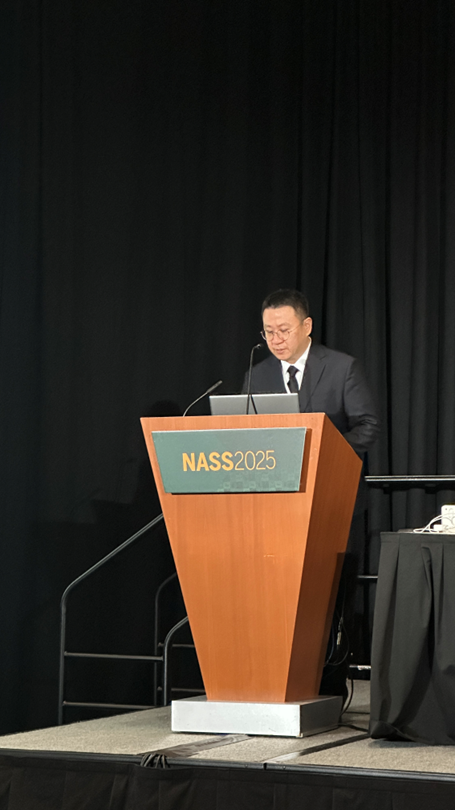
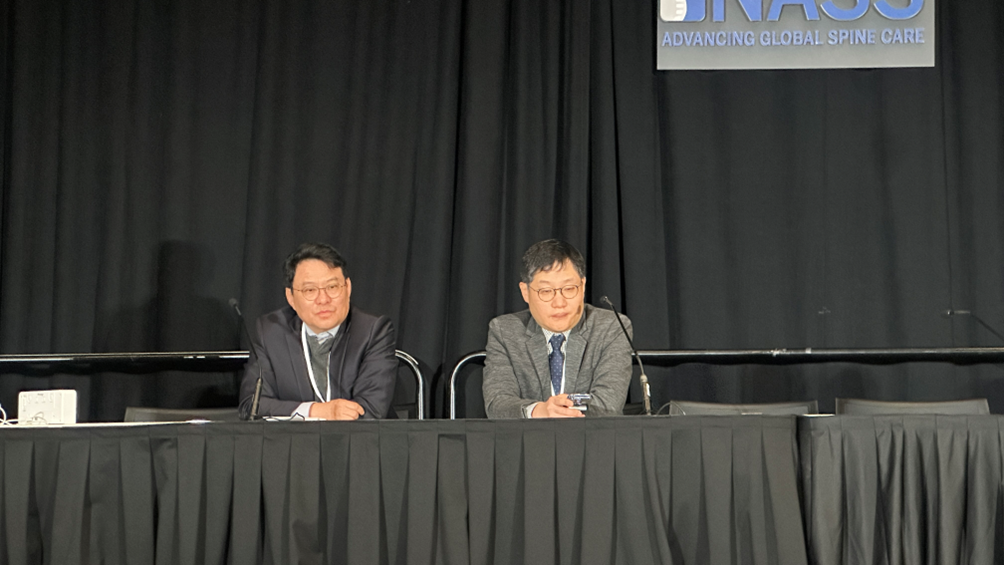
True to its title, "Innovation and Integration," this symposium was a highly efficient and perfect hour. It showcased the pride of our society in a natural progression—from
high-difficulty endoscopic techniques in the cervical, thoracic, and lumbosacral spine to future education paradigms and AI-based robotic workflows. Being there in person, I could feel that KOMISS and KOSESS have moved beyond merely introducing individual techniques; we are now proposing global standards and designing the future of the field at the center of the international stage.
In closing, I would like to express my deepest gratitude to Professors Chang-Il Ju and Jong-Tae Kim for leading the session with such dignity, and to all the speakers for clearly delivering key messages in their respective fields. I hope this achievement serves as a catalyst for expanding our international network, academic exchange, and the establishment of multicenter research and education systems, allowing our society to take yet another giant leap forward as a global leader.